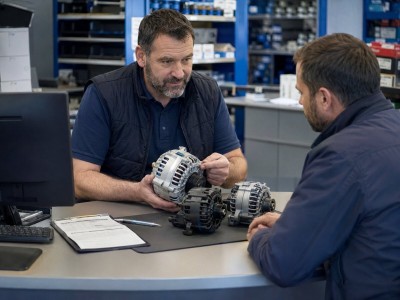



Many disputes between a repair shop and customer begin not with dishonesty but with different memories of the same event. The customer remembers approving one amount, the adviser recalls mentioning additional work, and the technician believes damage existed before the repair. When facts live in calls, chats and memory, the sequence is almost impossible to establish.
Records cannot guarantee that disputes disappear or replace good communication. Their purpose is to preserve a clear chain: initial vehicle condition, customer complaint, diagnosis, a defined estimate version, approval, completed work, fitted parts, payment and handover. A shared picture helps both parties reach a fair answer faster.
Common causes of repair disputes
The more breaks between service adviser, technician, parts specialist, warehouse and cashier, the more easily information changes. Verbal estimate changes and work started before confirmation are particularly risky.
| Situation | Customer's position | What records should show |
|---|---|---|
| New scratch | Damage appeared at the repair shop | Condition photographs and notes at check-in and handover |
| Total above expectation | Additional work was not approved | Estimate versions, lines, time and confirmation channel |
| Problem remains | Paid work did not produce the promised result | Complaint, diagnosis and actual outcome |
| Different part fitted | Another brand or number was approved | Selected line, warehouse issue and installation |
| Warranty declined | Terms and start date are unclear | Labour, part, mileage, duration and exclusions |
| Item missing from vehicle | It was present in the cabin | Contents recorded at check-in |
A chain of events matters more than a pile of forms
Hundreds of fields do not make a process reliable when completed retrospectively. Key facts should be recorded when they occur, retain an author and survive later order changes.
| Fact | When recorded | How it supports review |
|---|---|---|
| Condition and contents | Before the vehicle enters work | Separates pre-existing damage from new damage |
| Customer complaint | During booking and check-in | Defines the expected outcome |
| Diagnostic result | After technician inspection | Explains the proposed actions |
| Estimate version | Before each approval | Defines the precise agreement |
| Confirmation | Before additional work starts | Records accepted lines and limits |
| Actual completion | During and after work | Compares promise with outcome |
| Handover and advice | At visit completion | Closes the stage and future conditions |
Estimate versions must not be overwritten
If dismantling reveals another fault, create a new version with a change reason. The customer can see which lines were added, removed or amended, while the preceding version remains in history. Approval belongs to a specific version and selected lines.
“Do everything required” is too vague for a substantial repair. Record labour, parts, maximum amount and the condition that triggers another approval.
Inventory records identify the part used
A work order should contain the exact manufacturer, part number, quantity and source rather than a free-text description. Warehouse issue or purchasing connects to the repair. The technician confirms installation, while an unused item follows a separate return operation.
For a VIN-selected part, retaining the source OEM item, chosen cross-reference or alternative and additional applicability conditions allows the shop to review both the warehouse movement and the selection logic.
Records expose the internal process failure
Review should not become a search for an employee to blame. The event sequence can show a system gap: check-in missed damage, work started without approval, the warehouse issued a similar item or the technician failed to record the actual replacement.
| Process gap | What the system reveals | Rule to improve |
|---|---|---|
| Incomplete check-in | Required condition or photo is absent | Define a minimum checklist |
| Unapproved work | Start time precedes approval | Block unconfirmed lines from release |
| Wrong part | Warehouse issue differs from the order | Link stock movement to the repair line |
| Total changed | Estimate was overwritten without a version | Retain every significant change |
| Unclear responsibility | Action has no author or time | Record user and event |
| Lost recommendation | Diagnostic finding has no outcome | Close every finding with a status |
A practical dispute-review sequence
- Record the customer's complaint without a premature conclusion.
- Open the exact vehicle, visit and work order.
- Reconstruct check-in, diagnosis, estimate and approval chronology.
- Compare approved and completed work.
- Review parts movement and installation.
- Identify which fact is confirmed, missing or contradictory.
- Offer a resolution and separately correct the process failure.
Sensitive data access should be role-based, and changes should retain user and time. An internal operational record is not automatically legal evidence; requirements depend on documents, approval method and applicable law. It nevertheless makes internal review and customer communication substantially more reliable.
A connected operating flow
In the Business Reactor solution for repair shops, customer, vehicle, visit, labour, parts and payment belong to one process. VIN selection retains the origin of a selected part, while AutoParts connects the product to its registry, crosses and alternatives.
Good records return the discussion to verifiable facts. They protect customers from unapproved actions and the repair shop from unsupported accusations. Most importantly, the review identifies which operating rule should change so the same situation does not recur.