


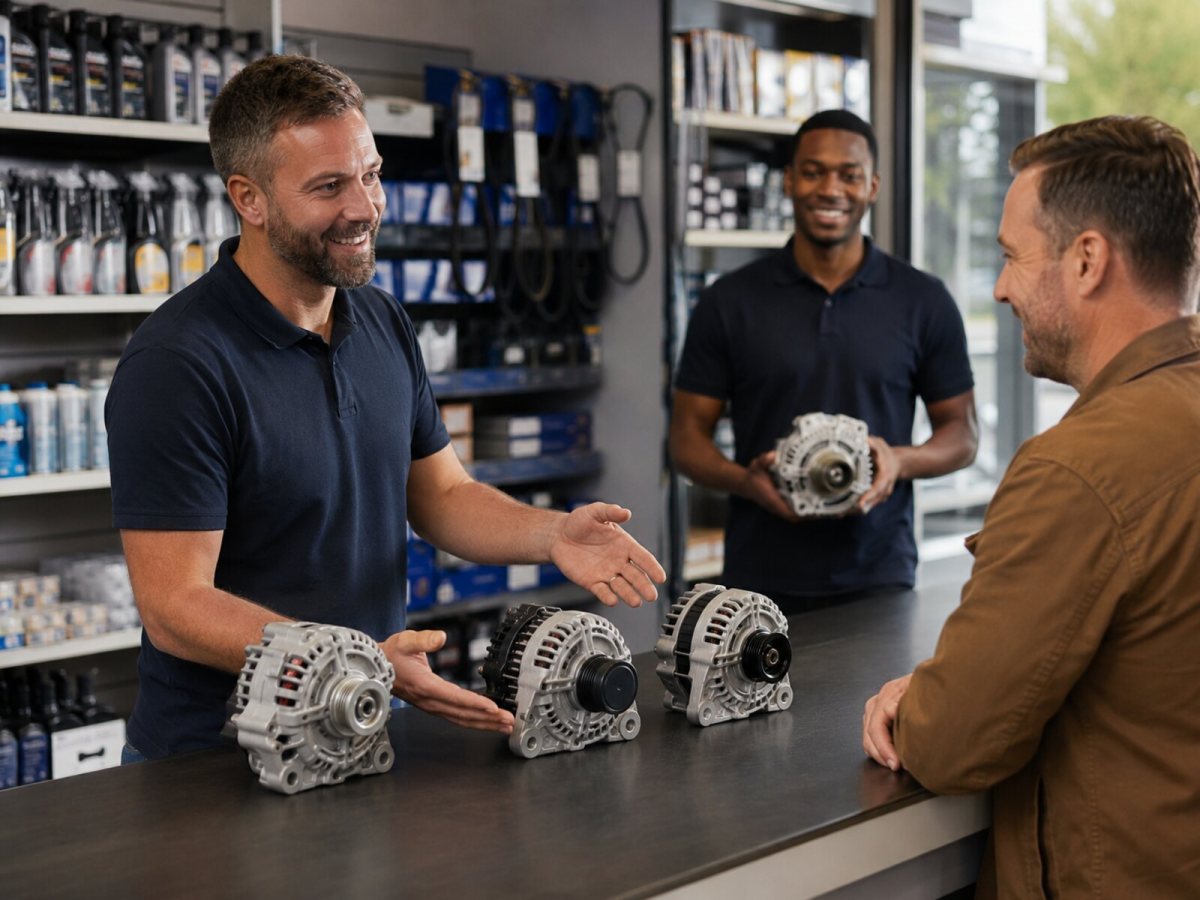
An auto parts customer is often not searching for a known product. They want to solve a vehicle problem and expect the seller to identify the required component. When staff ask too many questions, offer only one expensive item or ask the customer to find the part number, a proportion of enquiries end without an order.
Connected VIN selection and an automotive catalogue turn an uncertain enquiry into a commercial proposal. VIN identifies the vehicle and OEM item, the catalogue finds crosses and alternatives, and the product flow shows owned stock and supplier offers. Sales improve at every transition where the customer or information used to disappear.
Where an auto parts sale is lost
“Not available” often reflects a limited search rather than a genuinely unavailable component. The salesperson checked one number at one supplier and never reached substitutes. Another loss occurs when the answer takes hours and the customer receives a competitor's proposal first.
| Loss point | What happens | How the connection helps |
|---|---|---|
| Incomplete vehicle data | Staff ask repeatedly or search by assumption | VIN provides a precise starting configuration |
| First number not found | The customer receives a no-stock answer | OEM, crosses and alternatives extend the search |
| Only one price | The proposal does not fit the budget | Brands at different price levels are available |
| Unclear lead time | The customer cannot decide | Owned inventory and supplier offers are separated |
| Slow response | The enquiry moves to a competitor | Data continues without manual copying |
| No retained history | A repeat enquiry starts again | Vehicle and previous choice remain in CRM |
More options should not create more noise
The customer does not need one hundred similar rows. They need two or three justified choices: perhaps an original, a verified alternative and an available budget option with clear lead times. The catalogue expands the salesperson's search and then helps structure the result.
Every choice remains linked to its source OEM item, manufacturer, price, availability and expected date. Staff can explain the difference and record the customer's decision. That consultation is more likely to convert than a large unstructured list.
Mechanisms that change the commercial result
| Mechanism | Operational change | Commercial effect |
|---|---|---|
| VIN identification | Vehicle and specification are established faster | More enquiries reach a quotation |
| OEM relationships | Search begins from the original item | Fewer false matches |
| Crosses and alternatives | A replacement exists for an absent or costly item | Fewer no-stock rejections |
| Several suppliers | Price, quantity and lead time are compared | Better chance of acceptable terms |
| Owned inventory | Free stock and reservations are separate | Fast sale without a false promise |
| Customer history | Vehicle, enquiry and purchases are retained | Easier repeat and related sales |
Fewer returns mean more realised revenue
An order is not yet a high-quality sale. A wrongly selected component creates transport in both directions, traps working capital, consumes staff time and damages trust. Measure not only order conversion but also completed sales without compatibility returns.
VIN and catalogue data reduce risk when source vehicle data, applicability and the chosen option are retained. In a difficult case, the system should require another check rather than automatically promise compatibility. One extra question is cheaper than a complete return cycle.
Repeat sales begin with vehicle history
If CRM stores only a name and order value, the next enquiry begins by collecting the model and part number again. When vehicles, VINs, enquiries and fitted parts belong to the customer, staff understand the context immediately.
- service items can be found for an already known vehicle;
- the previous brand and price preference is visible;
- related components can be suggested for the current repair;
- a repeat enquiry does not require the VIN again;
- history supports warranty and return decisions.
Metrics that demonstrate the effect
Total revenue alone cannot prove the effect because advertising, seasonality and prices also change it. Capture enquiry-processing metrics before implementation, then compare equivalent periods and channels.
| Metric | What it indicates | Desired movement |
|---|---|---|
| Time to first quotation | Salesperson response speed | Down |
| Enquiries with a found part | Catalogue and relationship coverage | Up |
| Quotations with several choices | Ability to meet budget and timing | Up |
| Quotation-to-order conversion | Quality of the commercial response | Up |
| Compatibility returns | Selection accuracy | Down |
| Repeat orders | Use of customer and vehicle history | Up |
Test the process with real enquiries
Select completed and lost enquiries: a simple service part, a complex assembly, an unavailable original, a costly item and an enquiry with incomplete data. Compare the old and new processes by time, options found and manual transitions.
In the Business Reactor VIN selection module, the vehicle connects to assemblies, diagrams and OEM items. AutoParts continues through the registry, crosses, alternatives, images, owned inventory and supplier offers. This connection is included in the solution for auto parts stores.
A catalogue and VIN selection do not create sales automatically. They give staff more accurate answers in less time, make suitable choices possible and preserve the result. Connected to CRM, stock and orders, technical information becomes a measurable commercial process.