A reorder point is the inventory level at which replenishment must be triggered so that the next delivery arrives before the product runs out. Safety stock is the additional buffer used when demand is higher than expected or a supplier is late.
The base formula is simple: expected demand across the complete lead time plus safety stock. It must be applied to inventory position rather than physical stock alone, and the parameters must be recalculated when demand, suppliers or purchasing terms change.
Three decisions that must remain separate
Parameter
Question answered
What it does not determine
Reorder point
When to trigger replenishment
The new order quantity
Safety stock
How much buffer covers variation
Normal demand during lead time
Order quantity
How much to purchase
When purchasing should begin
A common error is placing a fixed large purchase as soon as physical stock looks low. Goods already on order, customer reservations and the actual consumption rate may all be omitted.
Base reorder-point formula
Reorder point = Average daily demand × Lead time in days + Safety stock.
Demand and lead time must use the same time unit. If demand is measured in working days, lead time must also be working days. If the warehouse consumes the product every day, calendar days are often more practical.
Calculate average demand from a comparable period and exclude days when sales were zero because stock was unavailable. Otherwise, the shortage reduces the future reorder point and reproduces itself.
What complete lead time includes
Lead time is more than time on a truck. Inventory control needs the complete path from the decision to buy until goods become available:
approving and sending the purchase order;
supplier confirmation and preparation;
transportation;
customs or other required procedures where applicable;
receiving and inspection;
warehouse put-away;
the moment the product becomes available for reservation and dispatch.
If a supplier promises five days but internal processing regularly adds two, the reorder point needs seven days.
The exact formula depends on the process. The essential controls are avoiding a duplicate purchase for stock already travelling and not treating customer-promised goods as freely available.
Status
Quantity
Effect on position
Physically in stock
170
+170
Confirmed by supplier
80
+80
Reserved for customers
60
−60
Backorders
10
−10
Inventory position
180
Decision basis
Worked reorder-point example
A product is consumed at an average of 20 units per day. Complete lead time is seven days and approved safety stock is 60 units.
Expected lead-time demand = 20 × 7 = 140 units.
Reorder point = 140 + 60 = 200 units.
Replenishment should be triggered when inventory position reaches 200 units or below. The position in the table is 180, so the condition has already been reached. This does not mean that 200 units should be ordered. Order quantity is a separate rule based on the period until the following delivery, supplier minimum and target stock level.
A simple safety-stock calculation
A transparent historical method can be used for initial setup:
Safety stock = Maximum daily demand × Maximum lead time − Average daily demand × Average lead time.
Assume maximum demand was 28 units per day, maximum lead time was nine days, average demand was 20 and average lead time was seven days.
28 × 9 − 20 × 7 = 252 − 140 = 112 units.
The method is conservative and sensitive to one-off extremes. An exceptional customer order or emergency delay can inflate the result. Review maximum values and determine whether they represent a repeatable risk before adopting the figure.
A statistical approach
With good history, safety stock can be linked to the target service level and variation of demand during lead time:
Safety stock = Service-level factor × Standard deviation of demand during lead time.
A higher target availability requires a larger factor and buffer. The same target should not be imposed automatically on every item: shortage of a critical A product and shortage of a rare substitutable C product carry different economic consequences.
When both demand and lead time vary, the model should account for both sources of uncertainty. A small business can begin with a transparent rule, test it against history and add complexity only where the economic effect justifies it.
Select an appropriate buffer
Factor
When the buffer increases
When it may decrease
Demand stability
Frequent unpredictable spikes
Consistent use and accurate forecast
Supplier reliability
Lead time is often missed
Delivery is stable and confirmed
Shortage cost
Production stops or an important order is lost
A substitute exists and the customer can wait
Shelf life
Only when shortage risk exceeds write-off risk
Short life and expensive disposal
Holding cost
Low relative to the lost sale
The item is expensive, bulky or quickly obsolete
Safety stock is a paid form of protection against uncertainty. Its size must reflect economics, not an attempt to guarantee that nothing is ever missed.
Seasonality and promotions
An annual average is unsuitable for a strong season. Before the peak, use the forecast for that specific period and the corresponding lead time. Lower the reorder point after the season to avoid excess.
Separate promotions from ordinary demand. Add planned promotional volume as a confirmed requirement rather than permanently increasing the average. After the promotion, inspect the remaining stock and restore the base parameters.
When parameters should be recalculated
purchase quantity or the supplier schedule changes;
average demand or its variation changes materially;
a new sales channel is introduced;
the supplier becomes slower or more reliable;
seasonality, price or the product’s role changes;
shortages recur even though the formal reorder point is followed;
inventory remains consistently excessive.
Stable X products may be reviewed monthly. Y and Z products need more frequent investigation of variation or a different replenishment method.
Common mistakes
The reorder point uses physical stock. Reservations and confirmed incoming supply are ignored.
Lead time comes from a supplier promise. Internal stages remain outside the calculation.
Average demand includes out-of-stock days. Future need is understated.
Safety stock is an arbitrary percentage. It is unrelated to risk and variation.
The reorder point is treated as order quantity. Excess inventory is created.
One rule is applied to the entire catalogue. Stable and irregular items are managed incorrectly.
Parameters are never reviewed. Old sales continue to control new purchasing.
A practical implementation sequence
Start with important AX and AY products and items that frequently run out.
Clean the history of out-of-stock periods and movement errors.
Calculate demand in one consistent time unit.
Measure complete actual lead time.
Select a transparent safety-stock method.
Calculate the reorder point.
Define inventory position including reservations and incoming supply.
Set the purchase-quantity rule separately.
Test parameters against prior periods.
After several cycles, measure shortages, average inventory and order fulfilment.
Replenishment control in Business Reactor
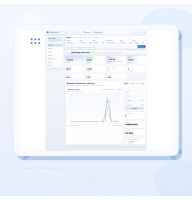
A reorder point is useful when it uses actual available stock, reservations, expected receipts and consumption speed. The system should show not only a purchase recommendation but also the data that produced it.
In Business Reactor, replenishment parameters can be connected to warehouse movements and company orders. The specific formula, supply statuses and inventory-position composition are defined around the live process to avoid duplicate purchases and false availability.
Conclusion
The reorder point determines when purchasing begins; safety stock protects against uncertainty. Calculate demand across the complete lead time, make the decision using inventory position and keep timing separate from order quantity.
If items still remain without movement after replenishment is configured, the next step is a dedicated review of slow-moving and excess inventory.Business Reactor Analytics and Control.