


A cash shortfall does not require an unprofitable business. A company may receive enough money during the month but lack it on payroll, tax or supplier-payment day. A monthly budget hides sequence; a payment calendar shows it by date.
Every receipt needs a source and confidence level. Every payment needs a due date, priority and owner. The closing balance after each date exposes future liquidity.
Minimum structure
| Field | Receipt | Payment |
|---|---|---|
| Date | Expected actual receipt date | Last acceptable or planned payment date |
| Counterparty | Customer or other source | Supplier, employee, authority or bank |
| Basis | Invoice, order or contract | Invoice, tax, schedule or obligation |
| Amount | Expected amount including part-payment | Amount to pay |
| Status | Confirmed, expected or at risk | Planned, approved or paid |
| Priority | Does not substitute for confidence | Critical, operational or deferrable |
| Owner | Who confirms customer payment | Who approves and processes payment |
Choose horizon and detail
An 8–13 week horizon works well for operations: plan the first two weeks by day and later periods by week, adding detail as they approach. A short calendar detects problems too late; a very long one with false precision creates noise.
Use a real opening balance
Do not simply add every bank account. Separate blocked and restricted funds, unsettled card receipts, borrowing limits and the minimum reserve.
Available opening cash = Bank and cash balances − Restricted funds − Protected liquidity reserve.
Do not treat every expected receipt as guaranteed
| Level | Evidence | Use |
|---|---|---|
| Confirmed | Paid, processing at bank or reliably documented | Base scenario |
| Expected | Invoice and agreed date exist, cash not received | Base scenario with active control |
| At risk | Unconfirmed promise or history of delay | Separate optimistic scenario |
| Potential sale | Deal is not complete | Must not fund mandatory payments |
The most dangerous error is funding guaranteed obligations with unconfirmed future sales.
Prioritise outflows
- Critical: payroll, tax, debt and payments that prevent production or dispatch stopping.
- Operational: normal purchasing, logistics, rent and essential services.
- Manageable: stock above minimum, experiments and non-critical purchases.
- Investment: equipment and projects that can be delayed without breaching current obligations.
Priority is not permission to breach a contract. It shows where an early agreement is required.
Example week
| Date | Opening cash | Receipts | Payments | Closing cash |
|---|---|---|---|---|
| Monday | UAH 180,000 | UAH 60,000 | UAH 90,000 | UAH 150,000 |
| Tuesday | UAH 150,000 | UAH 20,000 | UAH 35,000 | UAH 135,000 |
| Wednesday | UAH 135,000 | UAH 0 | UAH 160,000 | −UAH 25,000 |
| Thursday | −UAH 25,000 | UAH 140,000 | UAH 30,000 | UAH 85,000 |
The week is positive overall, but Wednesday has a UAH 25,000 gap. Early visibility allows the company to accelerate a confirmed receipt, move an agreed payment, split an amount or use a prepared facility.
Actions when a gap is forecast
- Validate the date and reliability of every receipt.
- Accelerate overdue receivables or obtain a lawful advance.
- Move only payments that can be renegotiated.
- Reduce purchases of excess inventory.
- Split a large payment by agreement.
- Prepare a borrowing facility before the day of need.
- Record the root cause so the gap does not repeat.
Plan versus actual
Update actual movements daily and move unpaid items to a new date with a reason. Monitor receipts arriving on schedule, unplanned payments, average customer delay, urgent approvals and the minimum forecast balance.
Common mistakes
- Updating monthly. The calendar stops being operational.
- Treating sales as receipts. A deal funds nothing before payment.
- No owner for expected dates. Customer promises are not checked.
- Deleting overdue payments. Obligations disappear from view.
- No reserve. Any variance creates a crisis.
- Solving the gap with more inventory on credit. The underlying problem moves forward.
Payment planning in Business Reactor
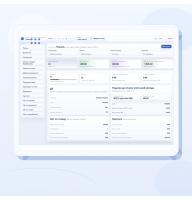
Business Reactor can build expectations from invoices, orders, contracts, purchases, taxes and schedules. Actual payments link to their basis, so moving a date does not hide the obligation.
Calendar quality depends on receivable control. Without reliable customer dates, expected receipts remain wishes.
Conclusion
A payment calendar shows the balance after each date. Use a real opening balance, separate confirmed and risky receipts, prioritise payments and compare plan with actual every day.
The next step is systematic receivable control so promised customer payments become forecastable cash. Business Reactor Finance & Accounting.