

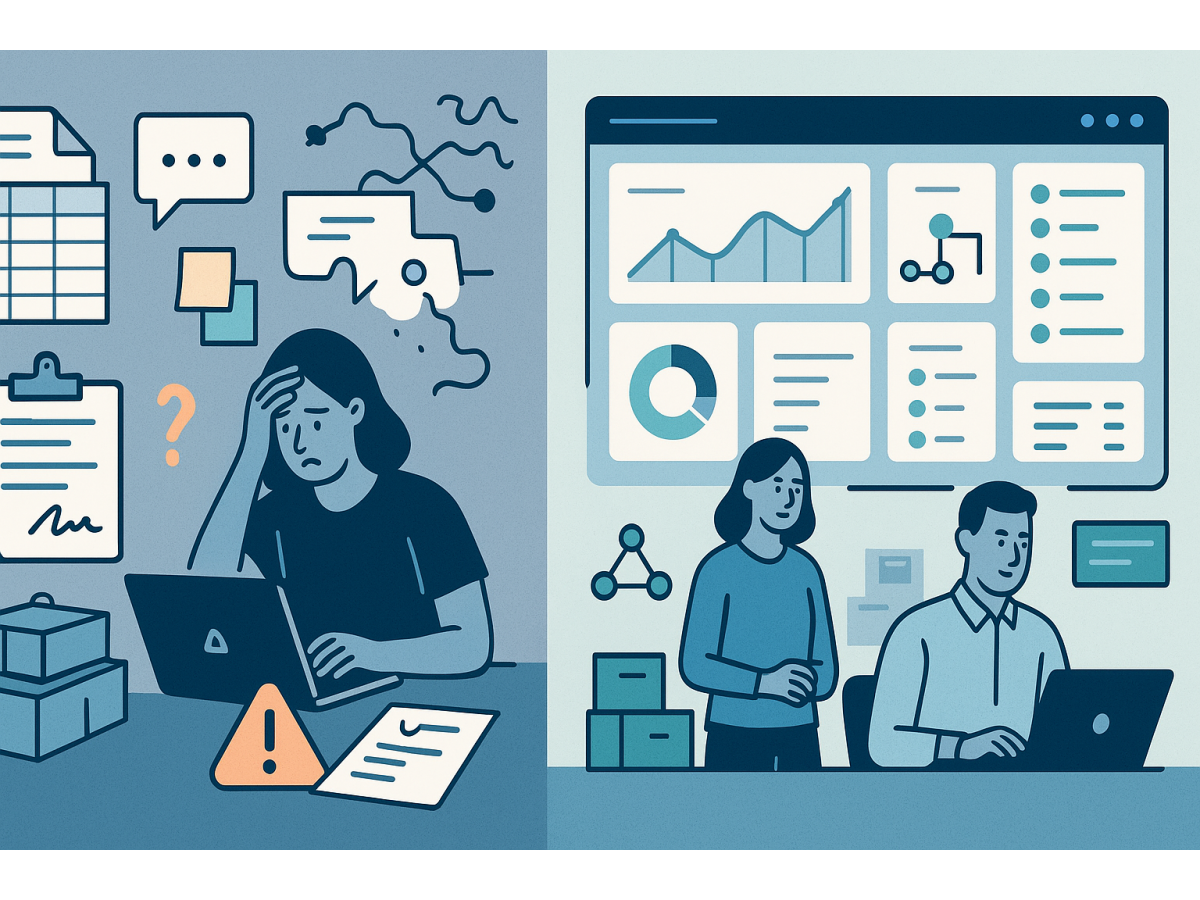
Why Manual Operations Quietly Drain Business Profit — and How Technology Restores Control
When a business is still small, manual management often feels efficient enough. Orders can be tracked in spreadsheets, issues can be clarified in chat, stock can be checked by asking the warehouse, and status updates can be handled through messages. In the early stage, this flexibility may even help a company move faster.
The problem starts when the business grows but the operating model does not. More orders, more customers, more staff, and more channels create complexity that manual coordination cannot absorb forever. At that point, spreadsheets, scattered chats, duplicated data entry, and constant personal supervision stop being harmless habits. They become a hidden source of financial loss, slow execution, and unstable customer experience.
This is why technology matters in a growing business. Not as a fashionable investment and not as technical infrastructure for its own sake, but as a practical way to reduce losses, improve accuracy, and restore visibility across operations.
Signs that manual operations are already hurting the business
Operational chaos rarely appears all at once. It usually grows gradually and becomes normalised inside the company. Teams get used to delays, managers get used to checking everything manually, and customer complaints are treated as isolated cases. But several warning signs usually point to a deeper structural issue.
- order, customer, or inventory data is stored in multiple disconnected places;
- employees constantly ask each other for updates in chats;
- the same information is entered manually more than once;
- reports take too long to prepare and different numbers do not match;
- orders, requests, or tasks are occasionally missed between teams;
- customers receive delayed or inconsistent responses;
- managers can keep things running only through personal control.
When these signs appear regularly, the issue is no longer about individual discipline alone. It means the process itself is too dependent on manual effort and too weak to scale reliably.
Where the losses actually come from
Manual work often looks cheap because the tools themselves seem inexpensive. A spreadsheet may cost nothing. A chat app is already there. A supervisor checking everything personally may feel like responsible management. But the real cost appears elsewhere.
First, there is the cost of time. Employees spend hours searching for information, verifying which version of a file is correct, asking for status updates, and re-entering data from one place to another. These are not visible line items in a budget, but they reduce productive capacity every day.
Second, manual workflows create avoidable errors. Repeated copying of order details, delivery data, customer information, payment status, or stock levels increases the chance of mistakes. A wrong status, duplicate order, or inaccurate inventory record may seem minor, but each one creates downstream cost through rework, delays, compensation, or lost trust.
Third, businesses lose efficiency through duplicated effort. Two people may work on the same request. Sales may promise something that operations cannot fulfil. Managers may spend their time validating information that should already be visible. The company remains busy, but not necessarily effective.
Fourth, customer experience becomes less reliable. When information is fragmented, it is harder to confirm availability, delivery timing, service history, or issue ownership. Customers do not always see the internal cause, but they feel the inconsistency. Over time, this affects repeat purchases and confidence in the business.
Finally, reporting and decision-making suffer. If management data is collected manually and arrives late, leaders are forced to make decisions based on partial information. That affects purchasing, staffing, delivery planning, service quality, and cash flow control.
Why growth makes manual control unsustainable
In a small company, weak processes can often be compensated for by the owner’s attention or a few highly involved employees. But as volume increases, complexity does not grow in a straight line. Every additional order, product line, warehouse movement, or customer interaction adds more dependency between people and data points.
That is why manual control becomes fragile during growth. The issue is not just higher workload. It is the growing number of handoffs, exceptions, and places where information can be delayed, misunderstood, or lost. The company may be selling more, yet feeling less in control.
A common response is to add more staff. Sometimes that is necessary, but if the process remains fragmented, more people simply create more coordination overhead. Without shared data, clear status logic, and transparent workflow, headcount alone does not solve operational chaos. It can make it more expensive.
What technology changes in practice
The value of technology is not in having more software. It is in creating one operational environment where critical information is visible, connected, and easier to act on. When customer, order, stock, and service data are linked instead of scattered, the business needs less manual chasing and fewer private clarifications.
In practical terms, technology can help standardise statuses, reduce duplicate entry, automate routine transitions, and show who is responsible for what. It can also improve visibility for managers by turning operational activity into usable reporting instead of manually assembled summaries.
This does not mean every business needs a huge transformation. Often the most important improvement is much simpler: one trusted flow for orders, one source of current data, and fewer places where errors can enter the process. The result is not abstract digital maturity, but a more accurate, faster, and more predictable business.
A short practical example
Imagine an online store that grew from a manageable daily order volume to several busy channels and a larger fulfilment team. At first, the team handled everything with spreadsheets and chat messages. Sales updated order notes manually, warehouse staff checked availability separately, and managers resolved exceptions in private conversations.
As volume increased, problems became frequent. Customers were promised items that were no longer available. Statuses were updated late. Some orders required repeated internal clarification before dispatch. Team members worked hard, but much of that effort went into coordination rather than delivery.
The company did not begin by automating everything. Instead, it mapped the order flow from incoming request to shipment and focused on the most expensive friction points: duplicated entry, unclear ownership, and poor stock visibility. By connecting those steps into a more structured digital process, it reduced confusion, improved response time, and gave managers a clearer view of delays without chasing people for updates.
How to approach implementation without creating more chaos
One of the biggest mistakes companies make is trying to digitise everything at once. That often overwhelms teams and turns a sensible improvement effort into another source of disruption. A better approach is to start with the losses that hurt the business most.
- Identify the workflows where delays, errors, or missed handoffs cost the most money or trust.
- Map how those processes actually work today, not how they are supposed to work on paper.
- Find the points of duplicate entry, hidden dependency, and unclear responsibility.
- Prioritise one or two critical workflows for the first stage of improvement.
- Introduce tools in a way that simplifies work rather than adding extra reporting burdens.
- Train the team and reinforce consistent data discipline after implementation.
This approach helps technology support the business instead of distracting it. It also makes it easier to measure whether change is real: faster order handling, fewer mistakes, better visibility, more accurate stock data, or improved customer response.
Common mistakes in late or poorly planned automation
Not every automation effort delivers value. One common mistake is digitising a broken process without redesigning it. In that case, the business simply moves confusion from paper and chat into software.
Another mistake is focusing on features instead of business outcomes. A system may look powerful, but if it does not reduce routine work, improve visibility, or remove friction from core operations, the investment will not solve the real problem.
It is also risky to wait too long. The longer a company depends on manual workarounds, the more habits, exceptions, and data inconsistencies it accumulates. That makes change harder and more expensive later.
And finally, companies often underestimate the human side. If teams do not understand why processes are changing and how the new model will make work clearer, adoption will remain weak even with the right tools.
Conclusion
Manual operations are not dangerous because they are old-fashioned. They are dangerous because, beyond a certain scale, they quietly consume profit, management attention, and customer trust. What looks like flexibility in an early-stage business can become a structural weakness in a growing one.
Technology helps when it is used to create order, visibility, and consistency around the workflows that matter most. If your business is already seeing delays, duplicated effort, reporting friction, missed orders, or constant dependence on manual supervision, that is not just a sign of growth. It is a sign that the operating model needs to mature.
The best time to act is before operational chaos becomes normal and expensive. In many cases, restoring control does not require a dramatic transformation. It starts with recognising where manual work is creating hidden losses and building a more connected process around those points first.