

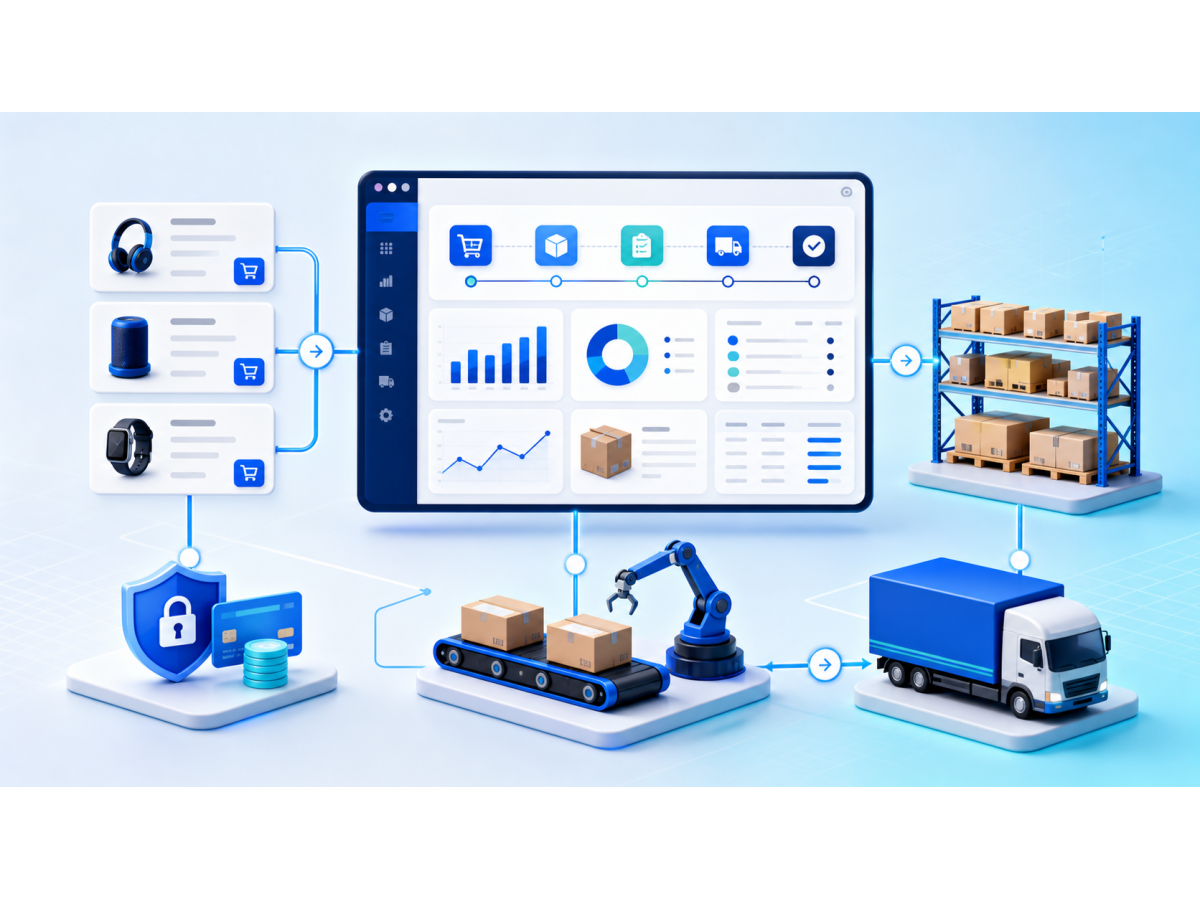
As a product business grows, the main challenge is rarely the number of orders. The challenge is that orders, inventory, payments, delivery and manager activity are spread across different spreadsheets and services. The team keeps copying data, customers wait for answers, and the owner sees results too late.
What product business automation really means
Automation is more than installing a CRM or an inventory application. It is one controlled workflow: a request enters the system, stock is checked and reserved, the manager sees the next action, payment is recorded, delivery receives correct information, and management gets current figures.
For a small or medium business, technology should not become an additional burden. The system must remove repetitive work, reduce errors and give the team a clear operating process.
Processes that should be connected
- Sales channels. Website, marketplaces, messengers and phone requests should create orders in one workspace.
- Inventory and reservations. Managers need reliable availability while the system reserves stock for confirmed orders.
- Payments. Prepayments, cash on delivery, refunds and balances should not require checks in several dashboards.
- Delivery. Shipment creation, tracking numbers and delivery status belong inside the order workflow.
- Analytics. Owners need practical answers: what sells, where margin is lost, which orders are delayed and which channel is profitable.
A practical end-to-end scenario
A customer places an order on the website. The system checks availability, reserves items and creates a manager task only when clarification is required. After confirmation, it prepares payment or delivery information. Each status change launches the next action: customer notification, stock write-off, delivery control or return processing.
This approach reduces the number of points where a person can forget an action or make an input error. Managers remain in control because they focus on exceptions while routine transitions are handled automatically.
How to start without disrupting current sales
- Map the real order journey from first contact to repeat purchase.
- Identify repetitive manual actions and frequent error points.
- Define one source of truth for products, stock, customers and payments.
- Launch one end-to-end workflow and test it on real orders.
- Add integrations and analytics after the core process is stable.
Start with the business process, not a list of modules. Explore our approach to trade automation and the available system integrations.
What the business gains
A well-designed system speeds up order processing, reduces inventory mismatches, provides reliable stock data and makes team performance predictable. Most importantly, the owner receives a complete operational picture without manually combining spreadsheets.
Business Reactor designs and implements this workflow around the company’s actual processes. Review our implementation options or request a demonstration to see how your sales scenario can work in one system.