

A company may have a healthy pipeline and still lose profit after the sale: stock was not reserved, purchasing started late, a service task was never assigned, payment was not reconciled, and management saw the result only at month end. This is when owners ask: do we need a CRM or an ERP?
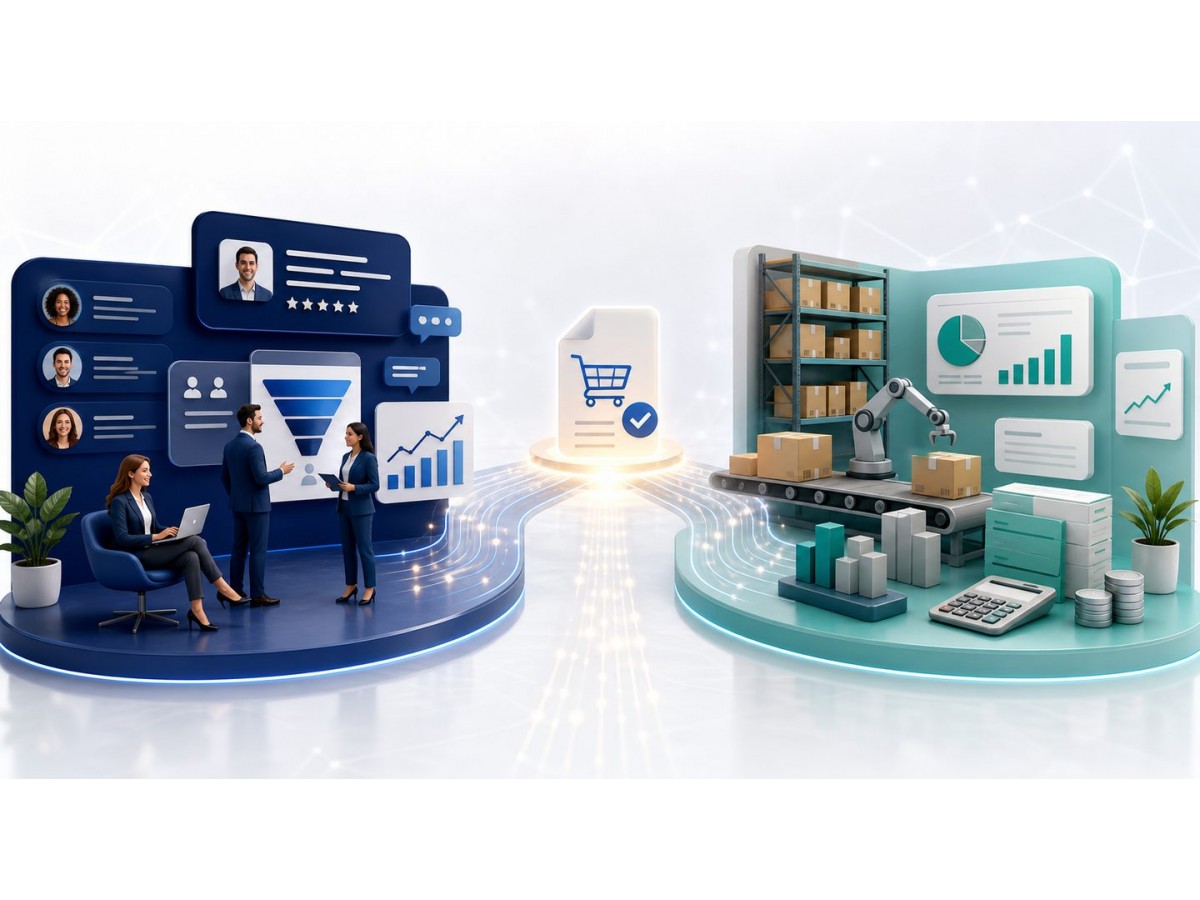
The short answer: CRM manages relationships and sales; ERP manages resources and fulfilment. The more useful question is where the flow from customer enquiry to cash and profit actually breaks.
CRM vs ERP at a glance
| Question | CRM | ERP |
|---|---|---|
| Main object | Customer, lead, opportunity, communication | Order, resources, inventory, money and fulfilment |
| Primary users | Sales, marketing and customer service | Warehouse, purchasing, production, finance and management |
| Main question | How do we acquire and retain a customer? | How do we fulfil the promise at a controlled cost? |
| Typical data | Contacts, calls, messages and opportunity stages | Stock, reservations, documents, expenses, payments and cost |
| Main outcome | A manageable sales process | A manageable operating process |
When a CRM is enough
Start with CRM when the primary problem occurs before the sale:
- enquiries are lost or remain unanswered;
- salespeople fail to record next actions;
- there is no unified customer history;
- management cannot see pipeline, conversion or loss reasons;
- fulfilment is still simple and transparent.
For a new company, this is often the right starting point. The important condition is that the selected platform can add operational scope later.
When ERP becomes necessary
ERP becomes a priority when losses arise after the opportunity is approved:
- recorded stock does not match physical stock;
- orders are not connected to reservation, purchasing or production;
- departments re-enter the same information;
- the owner cannot see margin, cost or cash movement;
- deadlines depend on manual coordination between sales and operations;
- the company has multiple warehouses, business lines or interdependent processes.
When CRM and ERP should work together
In product, manufacturing and mixed companies, two isolated systems often create new errors. A connected workflow looks like this:
- CRM receives the enquiry and records the customer’s need.
- Once approved, an order is created without duplicate entry.
- ERP checks available stock and creates a reservation, purchase requirement or production task.
- Shipment, delivery, documents and payment update the shared process status.
- Management sees not only opportunity value but actual fulfilment and financial result.
This is where the operational benefit appears: sales cannot promise what the business cannot deliver, while warehouse and finance no longer reconstruct context from messages.
CRM or ERP decision matrix
| Main symptom | Where to start |
|---|---|
| Leads and follow-ups are lost | CRM |
| Salespeople sell without current stock data | CRM plus inventory/ERP scope |
| Materials and production cost are inaccurate | ERP |
| Sales are healthy but fulfilment is consistently late | Connected CRM/ERP process |
| Management manually combines sales, stock and finance | ERP with analytics and CRM data |
Three common selection mistakes
- Automating departments instead of the process. Map the order journey first, then select modules.
- Buying every feature “for the future”. An oversized first phase slows adoption. Expand the system in controlled stages.
- Ignoring ownership and data rules. Even strong software cannot fix duplicate records and random statuses without operating rules.
The Business Reactor approach
Business Reactor is modular: CRM logic, products and sales, inventory, finance, manufacturing, analytics and integrations can operate inside one environment. A company does not need to launch everything at once; the scope can follow its real bottlenecks.
When workflows are already complex or require adaptation, consider Individual Implementation. The first step is not buying a feature list but diagnosing the chain “enquiry → order → fulfilment → payment → result”.
Conclusion
CRM is needed to retain customers and manage sales. ERP is needed to manage resources and deliver promises at a controlled cost. When sales, stock, finance and fulfilment already depend on one another, the best decision is usually not “CRM or ERP” but a well-designed connected process.